
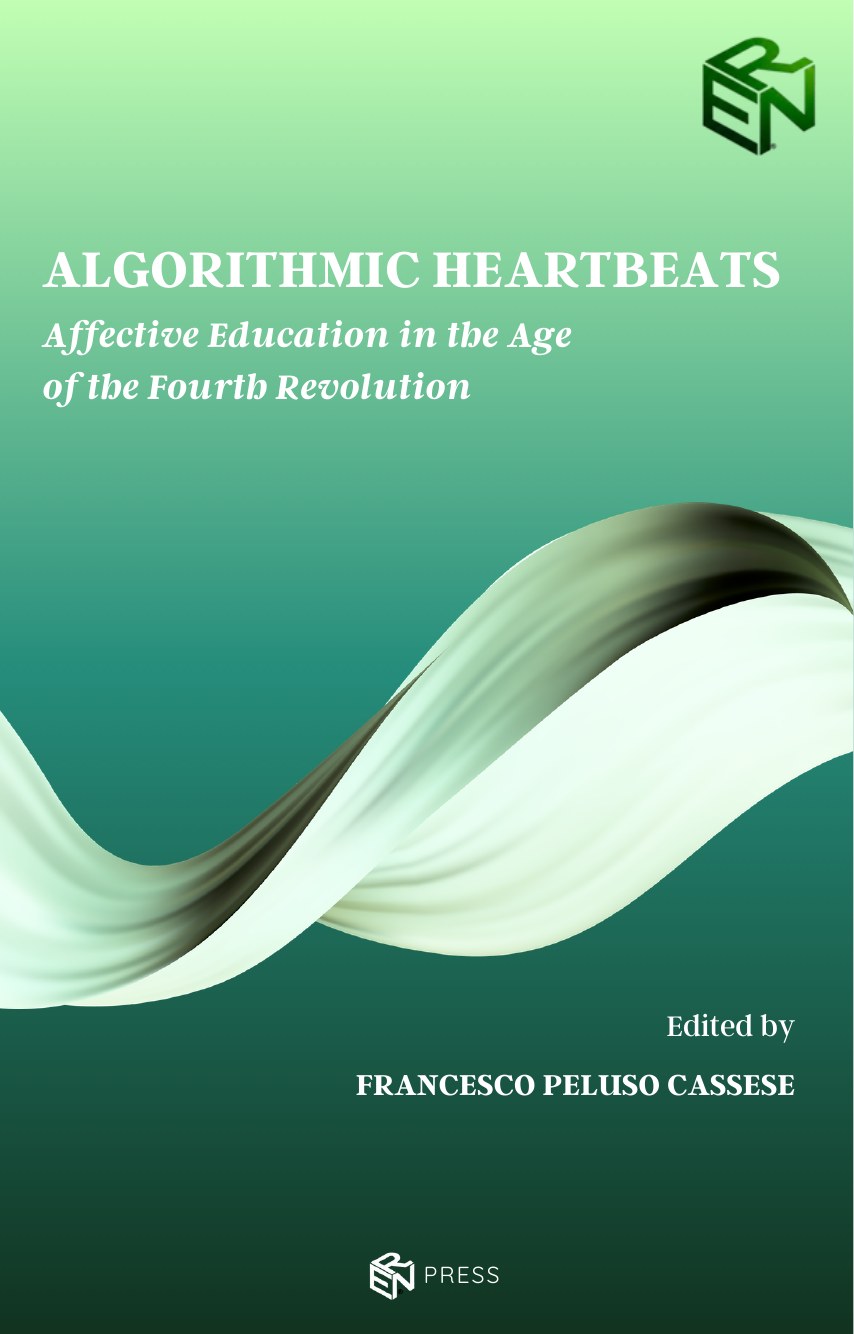

Edited by Francesco Peluso Cassese
| Publisher | REN Press – Cares srl |
| Year | 2026 |
| Series | REN Conference Book Series |
| ISBN | 979-12-82860-00-0 |
| DOI | https://doi.org/10.5281/zenodo.23211262 |
| Pages | 455 |
| Language | English |
| Licence | CC BY-NC-ND 4.0 – Open Access |
About the volume
This volume collects 181 contributions presented at the 6th REN International Conference (Naples and Ischia, 4–6 September 2026). It explores how artificial intelligence is reshaping the relational and emotional dimensions of education: from the ontology of care and the simulation of empathy to social robotics and socio-emotional inclusion, generative AI and narratives of the self, emotionally aware hybrid learning environments, digital affective literacy and citizenship, teacher education between the “Frankenstein Complex” and the D-Generation, and kinesiology and sport between education and performance. Across theoretical essays, empirical studies and reviews, the contributions converge on a shared question: how to design an education in which technology amplifies, rather than replaces, the human capacity for relationship.
Keywords: affective education; artificial intelligence; digital affective literacy; teacher education; inclusion; social robotics; physical education
Contents
Each chapter has its own DOI and can be downloaded and cited individually.
Topic 1 – Ontology of Care and the Simulation of Empathy (13 chapters)
- Are we heading towards a disembodied education?
Antonio Borgogni, Agnese Graticola, Dario Acquaroli, Silvia Sangalli · pp. 7–8 · DOI 10.5281/zenodo.23806989 - Simulating empathy: artificial Intelligence, ontology of care, and authenticity of the relational experience
Chiara D’Alessio, Martina Errico · pp. 9–10 · DOI 10.5281/zenodo.23806993 - Adolescence in the Digital Age: Caring Between Simulated Empathy and Authentic Relationality
Francesca De Vitis · pp. 11–12 · DOI 10.5281/zenodo.23806996 - Incarnate Care. The Importance of Touch
Edoardo Ghezzani · pp. 13–14 · DOI 10.5281/zenodo.23807000 - Preclinical Use of AI for the Early Detection of Mental Health Issues in Adolescence: Toward a Hybrid Human–AI Support Model
Maria Luisa Iavarone, Gaetano Monaco, Lorenzo Intermoia, Chiara Scuotto · pp. 15–17 · DOI 10.5281/zenodo.23807003 - What Kind of Educational Relationship Does a Large Language Model Construct? A Qualitative Analysis of Human Annotations in University Guidance Dialogues
Luna Lembo, Stefania Morsanuto, Giuseppe Caggianese, Agnese Augello, Pietro Neroni, Luca Sabatucci, Davide Perrotta, Francesco Peluso Cassese · pp. 18–20 · DOI 10.5281/zenodo.23807005 - Beyond the maimed teacher: human-environment-technology triangulations for a new ontology of care and social productivity
Salvatore Mancarella · pp. 21–22 · DOI 10.5281/zenodo.23807009 - The Algorithm Cannot Care, but It Can Support Care: Rethinking Affective Education in AI-Mediated Learning Environments
Michele Martulli, Alberto Fornasari, Rosa Minerva · pp. 23–25 · DOI 10.5281/zenodo.23807013 - Between simulated empathy and embodied care: a comparative review of the affective, relation and pedagogical dimensions in ai-mediated education
Immacolata Messuri, Matteo Conte, Ines Tedesco, Gaetano Monaco · pp. 26–27 · DOI 10.5281/zenodo.23807015 - Beyond the technosupercrip: neuro-body-divergence as a political space in the cripborg paradigm
Marianna Piccioli, Angela Magnanini, Marco D’Onofrio, Chiara Pannone · pp. 28–30 · DOI 10.5281/zenodo.23807019 - Building peace in the digital age: towards an ontology of care and human relations
Alessandra Priore, Federica De Marco, Domenico Licopoli · pp. 31–32 · DOI 10.5281/zenodo.23807021 - Loneliness, social support and psychological distress as correlates of emotional-relational engagement with conversational ai
Eugenia Treglia, Margot Zanetti, Francesco Peluso Cassese · pp. 33–34 · DOI 10.5281/zenodo.23807025 - Beyond the Shadows of the Digital Cave. Educational Care and Self-Regulation in the Hyperconnected Adolescent
Mariella Tripaldi · pp. 35–37 · DOI 10.5281/zenodo.23807035
Topic 2 – Social Robotics and Socio-Emotional Inclusion (9 chapters)
- Human-in-the-loop Artificial Intelligence for Socio-Emotional Learning in Autism: A Pedagogical Framework for Guided Interaction and Educational Responsibility
Lucia Campitiello, Anna Rescigno, Monica Di Domenico, Stefano Di Tore · pp. 38–39 · DOI 10.5281/zenodo.23807037 - Discovering and interacting with artworks using virtual mediators
Marco Caruso, Umberto Bilotti, Michele Domenico Todino · pp. 40–41 · DOI 10.5281/zenodo.23807043 - Social robotics for inclusive socio-emotional learning
Simona Iannaccone, Clorinda Sorrentino, Angelina Vivona · pp. 42–43 · DOI 10.5281/zenodo.23807048 - Building Relational Bridges: Social robotics, neurodiversity, and new frontiers of inclusion, enhancing participation and emotional development among students with special educational needs
Marco Moccia, Anna Barbato · pp. 44–46 · DOI 10.5281/zenodo.23807052 - Mirror neurons and artificial intelligence: educational pathways for socio-emotional inclusion in technology-mediated learning environments
Paola Pavone Salafia, Federica Pilotti, Emiliano De Mutiis, Gianluca Amatori · pp. 47–48 · DOI 10.5281/zenodo.23807058 - Between algorithm and agency: designing inclusion with universal design for learning in the age of generative artificial intelligence
Lia Daniela Sasanelli, Alfonso Filippone, Umberto Barbieri · pp. 49–50 · DOI 10.5281/zenodo.23807060 - Match analysis in team sports: a valuable educational tool for improving performance through feedback and effective communication
Domenico Scognamiglio · pp. 51–53 · DOI 10.5281/zenodo.23807062 - E-tutoring and Flipped Inclusion in university Virtual Learning Environments: a protocol for soft skills and socio-emotional inclusion
Silvia Tornusciolo, Aldo Caldarelli · pp. 54–55 · DOI 10.5281/zenodo.23807068 - Towards inclusive education mediated by social robotics: trainee educators’ perceptions of robotic systems analysis
Valeria Vadalà, Arianna Ricciardi, Rosabel Martinez-Roig, Nadia Carlomagno · pp. 56–59 · DOI 10.5281/zenodo.23807070
Topic 3 – Generative AI and New Narratives of the Self (16 chapters)
- In the mirror: rewriting of the self. The interaction between autobiographical practice and generative artificial intelligence.
Donatella Azzollini, Michele Baldassarre · pp. 60–62 · DOI 10.5281/zenodo.23807072 - Thinking of otherness in the era of ai. For a pedagogy of emotional intelligence in formal contexts
Mirca Benetton, Pierluca Turnone, Grazia Romanazzi, Giada Prisco, Chiara Bellotti, Michela Baldini, Angela Arsena · pp. 63–64 · DOI 10.5281/zenodo.23807076 - Evolutionary processes in corporate governance: pedagogical research perspectives.
Maria Carbone, Alessia Sozio, Tonia De Giuseppe · pp. 65–67 · DOI 10.5281/zenodo.23807079 - Making Teachers’ Professional Knowledge Observable
Filomena Maria Rosalba Cecere, Patrizia Oliva · pp. 68–69 · DOI 10.5281/zenodo.23807084 - Generative ai in the construction of teacher professional identity: a scoping review
Rossella D’Agostino, Ida Esposito, Emanuela Zappalà, ZahraSadat Mohajeri, Erika Marie Pace · pp. 70–73 · DOI 10.5281/zenodo.23807090 - From reflective journal to ai-mediated digital storytelling: fostering professional reflection in special education teacher training
Elisabetta Lucia De Marco, Annalisa Castellitti · pp. 74–76 · DOI 10.5281/zenodo.23807096 - Arts, Generative Technologies, and Appreciative Inquiry for inclusive teacher education: an exploratory study on the transformation of disability representations
Alessio Di Paolo, Flavia Capodanno, Naomi La Manna, Maurizio Sibilio · pp. 77–79 · DOI 10.5281/zenodo.23807101 - Algorithmic narratives and affective expression: a study on the impact of generative artificial intelligence on the emotional writing of students and future teachers
Alfonso Filippone, Maria Ermelinda De Carlo · pp. 80–82 · DOI 10.5281/zenodo.23807103 - AI-Mediated Listening and the Pedagogical Reconfiguration of Dialogue
Alberto Fornasari · pp. 83–84 · DOI 10.5281/zenodo.23807106 - From Creative Tool to Cognitive Prosthesis: Generative AI, Digital Storytelling, and Adolescent Development
Rossella Marzullo, Davide Milasi · pp. 85–86 · DOI 10.5281/zenodo.23807108 - From experience to narrative: artificial intelligence and digital storytelling in the processes of awareness within education
Paola Pela, Anna Borrasi, Chiara Gentilozzi · pp. 87–88 · DOI 10.5281/zenodo.23807110 - A.N.I.M.A.: An Experimental Pedagogical Model for Conscious Self-Narration in First-Cycle School
Francesco Sarcina, Anna Cuzzi, Giulia Ranieri · pp. 89–90 · DOI 10.5281/zenodo.23807113 - AI and narratives of the self
Alessandro Sola · pp. 91–92 · DOI 10.5281/zenodo.23807121 - Hybrid narratives: integrating artificial intelligence tools into the formative autobiography path for pre-service teachers
Valeria Tamborra, Martina Dicorato · pp. 93–94 · DOI 10.5281/zenodo.23807129 - The pedagogical value of narration in the age of Artificial Intelligence
Rosanna Tammaro, Concetta Ferrantino · pp. 95–96 · DOI 10.5281/zenodo.23807131 - Who narrates the self? Ai, educational mediation, and the transformation of relational practices
Tamara Zappaterra, Donatella Fantozzi, Jacopo Venè · pp. 97–99 · DOI 10.5281/zenodo.23807133
Topic 4 – Hybrid and “Emotionally Aware” Learning Environments (43 chapters)
- Embodied Inclusion in Emotionally Aware Hybrid Learning Environments: A Case Study on Visual Impairment
Addolorata Amadoro · pp. 100–101 · DOI 10.5281/zenodo.23807138 - From emotional data to pedagogical mediation: hybrid and emotionally aware learning environments in lower secondary schools
Lucia Ariemma, Romano Generoso · pp. 102–104 · DOI 10.5281/zenodo.23807140 - Emotional Competence in Pre-Service Support Teacher Education: Towards Digital Affective Literacy
Vincenza Barra, Antonio Giannone, Enza Manila Raimondo · pp. 105–106 · DOI 10.5281/zenodo.23807144 - Cognitive and Non-Cognitive Skills in Inclusive Schools: The Role of Hybrid Learning Environments
Patrizia Belfiore, Giovanni Tafuri, Generoso Romano · pp. 107–108 · DOI 10.5281/zenodo.23807152 - Digital Influence in Education Context: Algorithmic Infrastructures and Informed Inferences in the Age of Hypermediality
Angelo Cappello · pp. 109–111 · DOI 10.5281/zenodo.23807154 - Digital affective literacy and algorithmic mediation in the reconfiguration of educational relationships in higher education
Antonella Coppi, Sabrina Lucilla Barone · pp. 112–113 · DOI 10.5281/zenodo.23807156 - Algorithmic heartbeats of care: museotherapy, educational poverty, and affective mediation in vulnerable childhood contexts
Antonella Coppi, Debora Tringali · pp. 114–115 · DOI 10.5281/zenodo.23807158 - Artificial intelligence, emotional well-being, and difficult dialogues in school settings
Angelamaria De Feo, Chiara Bellotti · pp. 116–117 · DOI 10.5281/zenodo.23807166 - The Artificial Intelligence Between Empathetic Scaffolding and Emotional Drifts
Delio De Martino, Angelo Basta, Fabio Filosofi, Luca Bianchin · pp. 118–119 · DOI 10.5281/zenodo.23807168 - Emerging Technologies and Assessment Innovation in European Online Higher Education
Maria Clara Dicataldo, Federica Picasso, Irene Scierri, Andrea Tinterri, Anna Dipace, Pierpaolo Limone · pp. 120–121 · DOI 10.5281/zenodo.23807170 - Digital Technologies in Early Childhood Education Services: Pedagogical Reflections on the Inclusion of Deaf Children
Diana Carmela Di Gennaro, Umberto Veneruso · pp. 122–124 · DOI 10.5281/zenodo.23807175 - Hybrid and Emotionally Aware Learning Environments: an Experimental Study on Intelligent Educational Architectures
Davide Di Palma · pp. 125–126 · DOI 10.5281/zenodo.23807179 - Risky Play in Learning Environments: A Comparative Study of Educators’ and Families’ Perceptions
Elena Falaschi, Ezia Locantore, Maurizio Parente · pp. 127–128 · DOI 10.5281/zenodo.23807185 - Cultivating humanity in the age of AI: supervision as a space for emotional literacy
Alice Femminini, Irene Stanzione · pp. 129–130 · DOI 10.5281/zenodo.23807187 - Emotionally Aware Multisensory Environments: The Snoezelen Room as a Hybrid Approach for Supporting Well-Being in Adults with Autism Spectrum Disorder
Mariachiara Feresin, Eleonora Poles, Diletta Viezzoli, Esha Travascio, Luca Lissandron, Gabriele Brandolisio · pp. 131–132 · DOI 10.5281/zenodo.23807194 - Multisensory Synergies and Digital “Active Breaks”: Enhancing Executive Functions and Emotional Well-being
Francesco Gallo, Annamaria Curatola · pp. 133–134 · DOI 10.5281/zenodo.23807200 - From Algorithmic Responsiveness to Educational Responsibility: The Possibilities and Limitations of Artificial Empathy in Addressing University Dropout
Veronica Gardali, Nicolina Pastena · pp. 135–137 · DOI 10.5281/zenodo.23807202 - Mediating heritage in distributed educational environments. A framework for life soft skills assessment in n.o.t.e. project
Sara Gemma, Marta Raffone, Alessandra Natalini · pp. 138–139 · DOI 10.5281/zenodo.23807204 - Educational and teaching constructs in the practice of judo: smart training with the new technologies
Gianluca Gravino, Emma Saraiello · pp. 140–147 · DOI 10.5281/zenodo.23807208 - From Digital Interaction to Emotional Awareness: Artificial Intelligence, Non-Cognitive Skills and Cyberbullying
Francesca Latino, Francesco Tafuri · pp. 148–149 · DOI 10.5281/zenodo.23807212 - AR Concept Map in Primary School: A Pilot Study with SMapp
Clarissa Lella, Maria Sarno, Vasco D’Agnese, Anna Esposito, Franco Rubinacci, Raffaele Di Fuccio · pp. 150–152 · DOI 10.5281/zenodo.23807218 - Multilingualism and Multisensory Technologies: Towards Inclusive Digital Language Learning
Fabrizio Liguori, Domenico Tafuri · pp. 153–155 · DOI 10.5281/zenodo.23807221 - Digital and Physical Learning Spaces for Student Athletes
Mattia Caterina Maietta, Maria Giovanna Tafuri · pp. 156–157 · DOI 10.5281/zenodo.23807223 - Beyond self-report: evaluating authentic ai literacy in a continuing education context
Marika Mascitti, Paola Rigoni, Chiara Panciroli, Anita Macauda · pp. 158–159 · DOI 10.5281/zenodo.23807225 - Embracing the enigma and learning through emotions. Digital escape rooms as narrative, multisensory, and challenge-based environments in primary school
Francesco Milito, Alessandro Barca · pp. 160–161 · DOI 10.5281/zenodo.23807230 - Human-Centered Automl for Early Student Dropout Prediction in Higher Education
Muhammad Amin Nadim, Emanuele Marsico, Usman Nawaz, Raffaele Di Fuccio · pp. 162–163 · DOI 10.5281/zenodo.23807233 - Advancing Learning Analytics through Quantum-Enhanced Machine Learning: A Framework for Dropout Prediction and Intervention
Muhammad Amin Nadim, Emanuele Marsico · pp. 164–165 · DOI 10.5281/zenodo.23807238 - Design and Experimental Evaluation of an Emotion-Sensitive Hybrid Learning Ecosystem to Promote Psychological and Physical Well-Being in Primary Schools
Fabiola Palmiero, Giovanni Tafuri · pp. 166–167 · DOI 10.5281/zenodo.23807244 - Designing hybrid and emotionally aware learning environments: the contribution of multisensory
Daniela Pasqualetto, Alessandra Lo Piccolo · pp. 168–170 · DOI 10.5281/zenodo.23807250 - The Algorithmic Heartbeat: The Iep As An Affective Device In Ai-Enhanced Hybrid Learning Environments
Sara Pellegrini, Filippo Gomez Paloma, Antonio Cuccaro, Riccardo Mancini, Riccardo Sebastiani · pp. 171–172 · DOI 10.5281/zenodo.23807256 - Outdoor education and artificial intelligence: an integrated pedagogical framework for personalized, situated, and sustainable learning
Giorgia Peluso Cassese, Walter Savarese, Stefania Morsanuto · pp. 173–174 · DOI 10.5281/zenodo.23807258 - Human Mediation and Technical–Procedural Learning in the Age of AI: A Retrospective Study of a Peer-Led BLS Program in an Italian Lower-Secondary School
Maria Vincenza Pistillo · pp. 175–176 · DOI 10.5281/zenodo.23807260 - Open Digital Spaces as Emotionally Aware Learning Environments: A Collaborative Experience in TFA Programs
Angela Ruotolo · pp. 177–178 · DOI 10.5281/zenodo.23807264 - Visual impairment and empathy: the potential of assistive technologies
Davide Saggese, Giovanni Petrillo, Diana Carmela Di Gennaro · pp. 179–181 · DOI 10.5281/zenodo.23807266 - Between Presence and Distance: New Perspectives for Students on Hybrid University Education
Francesco Paolo Salemme, Francesco Girardi, Arturo Puoti · pp. 182–183 · DOI 10.5281/zenodo.23807270 - Immersive Learning Environments for Inclusion: A Pilot Study on the Perceptions of In-service Teachers
Tommaso Santilli, Catia Giaconi, Noemi Del Bianco, Ilaria D'Angelo · pp. 184–187 · DOI 10.5281/zenodo.23807274 - Hybrid learning for inclusion and classroom well-being
Emma Saraiello, Gianluca Gravino · pp. 188–189 · DOI 10.5281/zenodo.23807276 - The Algorithmic Heartbeat in Prompt Engineering: Educating for New Digital Literacies through the Prompt Battle.
Fernando Sarracino, Lucia Ariemma, Jolanda Edda Squillaci · pp. 190–192 · DOI 10.5281/zenodo.23807280 - Hybrid and emotionally aware learning environments and digital affective literacy: a mixed-method study on well-being, engagement and inclusion in secondary schools
Giovanna Scala, Maria Giovanna Tafuri · pp. 193–195 · DOI 10.5281/zenodo.23807284 - The Irreducible Dimension: Toward an Integration of Automated Tutoring and Mentoring in AI-Supported Education
Sara Selmi, Guido Scarano, Lucia Martiniello · pp. 196–197 · DOI 10.5281/zenodo.23807289 - The Virtual Museum as an Inclusive Learning Environment: Teachers’ Perceptions of AI, Flipped Inclusion and Digital Wellbei ng
Alessia Sozio, Maria Carbone, Tonia De Giuseppe · pp. 198–200 · DOI 10.5281/zenodo.23807293 - Digital spaces and augmentative and alternative communication (aac). Towards emotionally aware inclusive digital learning spaces.
Domenico Tafuri, Lucia Valentino · pp. 201–204 · DOI 10.5281/zenodo.23807295 - Pedagogy and teaching in emergency contexts in the age Of artificial intelligence: towards a human-centred Framework for educational continuity, inclusion and Resilience
Barbara Zarrillo, Walter Savarese, Giorgia Peluso Cassese · pp. 205–207 · DOI 10.5281/zenodo.23807297
Topic 5 – Digital Affective Literacy and Citizenship (32 chapters)
- Thinking Routines and new Italian Guidelines 2026.
Antinea Ambretti · pp. 208–210 · DOI 10.5281/zenodo.23807305 - Inhabiting the Algorithmic Pulse: Affective Digital Literacy and Critical Citizenship in the Era of the Fourth Revolution
Giovanna Amendola, Rolando Fiore, Fortunata Romano, Fabrizio Schiavo, Pio Alfredo Di Tore · pp. 211–212 · DOI 10.5281/zenodo.23807311 - Affective digital literacy and citizenship a quasi-experimental study in primary school
Antonio Ascione, Ilenia Amati · pp. 213–214 · DOI 10.5281/zenodo.23807315 - Beyond the Digital Divide: AI as Linguistic and Affective Mediation Tool among Migrant Students
Alba Caiazzo, Francesco Pio Dilillo · pp. 215–216 · DOI 10.5281/zenodo.23807319 - Socio-Emotional and Affective Education in the Age of AI
Nadia Carlomagno, Arianna Ricciardi, Valeria Vadalà, Rosabel Roig-Vila · pp. 217–218 · DOI 10.5281/zenodo.23807323 - When Algorithms Learn to Speak: Debate as Affective Education in the Age of Artificial Intelligence
Rosa Carnevale · pp. 219–221 · DOI 10.5281/zenodo.23807325 - Resisting the Algorithm: Affective Literacy as a Relational Compass
Santina Carrozza, Paolo Siclari · pp. 222–223 · DOI 10.5281/zenodo.23807327 - The Role of Soccer eSports in Promoting Relational Awareness and Digital Responsibility
Rosario Ceruso · pp. 224–225 · DOI 10.5281/zenodo.23807332 - Artificial Intelligence in Higher Education: Student Perceptions and the AI-mediated University Digital Citizenship Framework
Emilio Crisol Moya, María Asunción Romero, Vanesa María Gámiz Sánchez · pp. 226–228 · DOI 10.5281/zenodo.23807334 - Families in motion. The role of culture and media in the recognition of plural family experiences. A preliminary data analysis
Emilio Crisol Moya, Andrea Fiorucci · pp. 229–230 · DOI 10.5281/zenodo.23807336 - Teaching beyond the machine: a three-year model of affective education and teacher transformation
Antonio Cuccaro, Filippo Gomez Paloma · pp. 231–235 · DOI 10.5281/zenodo.23807338 - Violence, algorithms, and school: A quasi-experimental investigation into the effectiveness of digital affective literacy in middle school
Francesco Del Sorbo, Rosa Indellicato · pp. 236–237 · DOI 10.5281/zenodo.23807342 - Access to information and communication barriers in migrant integration processes: evidence from a qualitative study in Poland
Francesco Pio Dilillo, Laura Sara Agrati · pp. 238–239 · DOI 10.5281/zenodo.23807346 - Affective Affordances in AI-Mediated Learning: A Scoping Review on Adolescent Motivation and Psychological Needs
Francesco Facciorusso, Marilena Di Padova · pp. 240–241 · DOI 10.5281/zenodo.23807350 - Digital Affective Literacy and Digital Well Being Awareness in Teacher Training Contexts
Ilaria Fiore, Laura Pia Schiavone · pp. 242–243 · DOI 10.5281/zenodo.23807354 - Teachers’ Cultural Positionings and Attitudes of Artificial Intelligence in Education: Evidence from an Italian Descriptive Study
Andrea Fiorucci, Alessia Bevilacqua · pp. 244–246 · DOI 10.5281/zenodo.23807356 - AI and development of critical thinking and emotional awareness in primary school: the "Sensitive-Extended Reality" (SXR) Environments
Emanuela Guarcello · pp. 247–248 · DOI 10.5281/zenodo.23807362 - Digital affective literacy and artificial intelligence in lower secondary school.
Rita Carmela Fabiola Imperatrice, Giusi Antonia Toto · pp. 249–251 · DOI 10.5281/zenodo.23807364 - Impact of game digital intervention for physical health and quality of life in children as tool pharmacy: systematic review
Teresa Iona, Miriam Galloro, Marianna Vaccaro, Vera Gramigna · pp. 252–254 · DOI 10.5281/zenodo.23807366 - Self-Regulated Learning and Prosocial Behavior: Implications for Digital Affective Literacy
Marika Lamacchia, Marilena Di Padova · pp. 255–256 · DOI 10.5281/zenodo.23807370 - Telling otherwise: training youth worker for LGBTQIA+ storytelling in the Queer Media Education framework
Salvatore Messina, Marika Mascitti · pp. 257–258 · DOI 10.5281/zenodo.23807378 - Beyond the digital divide: parents' use of artificial intelligence in contexts of social marginality
Carmen Lucia Moccia, Cristina Promentino, Filomena Izzo, Ilaria Viola, Fausta Sabatano · pp. 259–261 · DOI 10.5281/zenodo.23807380 - Mentoring and strategic vision for inner areas: Experiential background for cascade teacher training
Carmela Paladino · pp. 262–263 · DOI 10.5281/zenodo.23807384 - Judging, Reasoning, and Deliberation: Techno-Aesthetic Pathways for Responsible Encounters with Artificial Intelligence
Francesca Pileggi · pp. 264–265 · DOI 10.5281/zenodo.23807386 - Beyond the Pitch and the Screen: Affective Self-Exclusion in Sport and Digital Life among Italian Pre-Adolescents
Andrea Pisaniello, Alessandro Figus, Diana Spulber · pp. 266–267 · DOI 10.5281/zenodo.23807390 - Intersectional perspectives in designing empirical research. A questionnaire for exploring adolescent and youth language in the post-pandemic context
Francesco Paolo Romeo, Luana Rodriquez, Sabrina Carbone · pp. 268–269 · DOI 10.5281/zenodo.23807392 - From Cognitive-Affective Vulnerabilities to Digital Agency: A Pedagogical Model to Address Algorithmic Manipulation
Domenico Rubino, Anna Maria Mariani · pp. 270–272 · DOI 10.5281/zenodo.23807394 - From Pedagogical Mediation to Algorithmic Presence: Generative AI and the Transformation of the Educational Relationship
Giuseppe Russo, Luigi Felaco · pp. 273–274 · DOI 10.5281/zenodo.23807398 - The invisible teacher: Algorithms, emotions, and the construction of the Self in digital cultures
Maria Sammaro, Elena Zagari · pp. 275–276 · DOI 10.5281/zenodo.23807402 - Affective Education and the Pedagogy of Desire for Teacher Training in the Digital Affective Era
Anna Daniela Savino · pp. 277–278 · DOI 10.5281/zenodo.23807404 - Educational Pathways Aimed at Developing Students’ Critical Thinking and Emotional Awareness in Relation to Algorithmic Manipulation and Social Media
Nicola Tenerelli · pp. 279–280 · DOI 10.5281/zenodo.23807410 - Emotions under algorithms: SEL didactic pathways for Digital Affective Literacy and Algorithmic Citizenship
Giuseppe Valentino · pp. 281–283 · DOI 10.5281/zenodo.23807412
Topic 6 – Teacher Education Between the “Frankenstein Complex” and the D-Generation (33 chapters)
- Beyond Technical Expertise: ARISE-AI as an Adaptive, Responsive and Socio-Educational Framework for Understanding Teachers’ Relationship with Artificial Intelligence
Matteo Adamoli, Federica Emanuel, Marco Rondonotti, Michele Marangi, Paolo Raviolo · pp. 284–286 · DOI 10.5281/zenodo.23807415 - Opportunities and risks of AI in lesson planning: insights from pre-service teachers
Laura Sara Agrati, Arianna Beri · pp. 287–288 · DOI 10.5281/zenodo.23807423 - Teaching in the Age of Artificial Intelligence: Between Paradigm Shift and the “Frankenstein Complex” in Educational Practices
Antonella Bambacaro, Francesco Paraggio, Rosanna Tammaro · pp. 289–290 · DOI 10.5281/zenodo.23807426 - Rethinking homework between dialogic space and instructional design
Barbara Bocchi · pp. 291–292 · DOI 10.5281/zenodo.23807428 - Inclusive co-design and AI devices: a new paradigm of pedagogical mediation for schools
Aldo Caldarelli, Lucia Borsini · pp. 293–295 · DOI 10.5281/zenodo.23807432 - Artificial intelligence as a narrative mirror: inclusive storytelling practices in teacher education
Rossana Campanale, Angela Ruotolo, Federica Pepe · pp. 296–297 · DOI 10.5281/zenodo.23807434 - Faculty Development for Proximity: Training Faculty and Tutors in Synchronous Digital Teaching at Pegaso University
Maria Concetta Carruba, Elisabetta Lucia De Marco · pp. 298–299 · DOI 10.5281/zenodo.23807442 - Pre-service teachers' perceptions of Artificial Intelligence: an exploratory study on current uses and professional projections
Martina Casillo, Ettore Melchionna · pp. 300–301 · DOI 10.5281/zenodo.23807444 - Investigating the digital competence of in-service teachers through the digcompedu framework
Bianca De Vivo, Valeria De Padova, Anna Dipace, Andrea Tinterri · pp. 302–303 · DOI 10.5281/zenodo.23807446 - Digital cognitive capital and generative AI: RAG Socrate as a methodological environment for epistemic awareness
Monica Di Domenico, Pio Alfredo Di Tore · pp. 304–306 · DOI 10.5281/zenodo.23807448 - Artificial Intelligence and school leadership in inclusive organisational processes.
Michele Formica, Carmen Lucia Moccia, Flavia Capodanno, Ilaria Viola, Fausta Sabatano · pp. 307–310 · DOI 10.5281/zenodo.23807452 - AGI as a prompt in the inclusion process: a preliminary study on teachers' professional resources.
Antonio Giannone, David Martínez-Maireles, Vincenza Barra, Marinella Muscarà · pp. 311–312 · DOI 10.5281/zenodo.23807456 - From the Workplace to the Classroom: A Mixed-Methods Approach to Measuring AI-Related Creativity. The AICREA Scale and a Qualitative Analysis of SME Managers
Valentina Giordano, Giuseppe Carci, Andrea Laudadio, Irene Petruccelli, Flavia Bonaiuto, Alessia Gargano · pp. 313–314 · DOI 10.5281/zenodo.23807458 - Between Technical Efficiency and Affective Resistance: Evidence for an Ethical Integration of AI in Teacher Training
Iolanda Sara Iannotta, Deborah Gragnaniello · pp. 315–316 · DOI 10.5281/zenodo.23807460 - Supporting IEP Selection in Italy: A Mathematical Decision-Support Model Based on Screening Data
Erika Inderst, Luigi Iovino, Angelo Rega · pp. 317–318 · DOI 10.5281/zenodo.23807466 - Attitudes Toward Artificial Intelligence in Teacher Education: The Contribution of Cognitive and Emotional Variables
Luna Lembo, Anna Maria Mariani, Francesco Peluso Cassese · pp. 319–320 · DOI 10.5281/zenodo.23807468 - AI in teaching for a digital humanism: ethical conditions, critical training of teachers and the primacy of the educational relationship
Giuseppe Liverano · pp. 321–322 · DOI 10.5281/zenodo.23807472 - Designing with AI, Teaching the Body: A Pilot Study on Pre-Service Teacher Training for Embodied Emotional Literacy
Dario Lombardi · pp. 323–324 · DOI 10.5281/zenodo.23807476 - From Frankenstein to IoToys: educating between control and autonomy in the age of datafication
Silvestro Malara, Fabiana Milardi · pp. 325–326 · DOI 10.5281/zenodo.23807479 - Between Algorithm and Relationship: The Perceptions of Future Support Teachers on Artificial Intelligence
Ettore Melchionna, Martina Casillo · pp. 327–328 · DOI 10.5281/zenodo.23807487 - Artificial Intelligence as a mediation device: towards an epistemological redefinition of active teaching through the 5E Model
Immacolata Messuri, Matteo Conte, Ines Tedesco · pp. 329–330 · DOI 10.5281/zenodo.23807489 - Human Agency First: Educators as Co-Designers of Educational AI Tools
Bogdan Novakovic, Giovanna Di Rosario, Paolo Maria Ferri · pp. 331–333 · DOI 10.5281/zenodo.23807491 - University Professors' Favorable Disposition Toward AI-Based Diagnostic Assessment
Antonella Nuzzaci · pp. 334–340 · DOI 10.5281/zenodo.23807495 - AI and Gamification for Inclusive and Engaging Learning: A Preliminary Scoping Review
Francesco Palma, Valeria De Padova, Gianluca Amatori · pp. 341–342 · DOI 10.5281/zenodo.23807497 - Media education, digital literacy, and teacher education: pedagogical perspectives on the critical construction of meaning in digital contexts
Letizia Pistone, Laura Andolina, Alessandra Lo Piccolo · pp. 343–344 · DOI 10.5281/zenodo.23807501 - Teaching in the age of AI: Mapping pre-service special education teachers’ orientations between resistance and fascination
Enza Manila Raimondo, Concettina Caparello, Marinella Muscarà · pp. 345–346 · DOI 10.5281/zenodo.23807503 - A Teacher Training Model for the Age of AI. Integrating Critical Use and Relational Competences
Alberto Righi, Arianna Taddei · pp. 347–348 · DOI 10.5281/zenodo.23807505 - Innovative language teacher education approaches integrating ai-assisted models
Teresa Savoia, Oleksandra Zagorulko · pp. 349–350 · DOI 10.5281/zenodo.23807509 - The Coordinating Tutor as an Emotional Compass: Reflective Mentorship to Overcome the ‘Frankenstein Complex’ in Teacher Training Programmes.
Silvia Scipilliti, Alfredo Leotta, Simona Morlino · pp. 351–353 · DOI 10.5281/zenodo.23807511 - Can care be simulated? teachers’ judgments of educational messages in the age of generative AI
Riccardo Sebastiani, Riccardo Mancini, Sara Pellegrini · pp. 354–355 · DOI 10.5281/zenodo.23807517 - Teacher education, Artificial Intelligence, educational complexity: empirical evidence and pedagogical perspectives
Maria Tiso, Iolanda Sara Iannotta · pp. 356–357 · DOI 10.5281/zenodo.23807523 - Between Inclusion and Innovation: Pre-Service Special Education Teachers' Pedagogical Attitudes and Professional Co-Agency with Generative AI
Mariagrazia Verbicaro, Patrizia Oliva · pp. 358–360 · DOI 10.5281/zenodo.23807528 - Orchestrating Hybrid Environments: A STIAEM Pilot Study on Teacher Identity and Algorithmic Ethics
Viviana Vinci, Pierangelo Berardi · pp. 361–363 · DOI 10.5281/zenodo.23807530
Topic 7 – Kinesiology and sport between education and performance in European area (35 chapters)
- The educational value of competitive dancesport in adolescent athletes: perceived well-being, sports values and parental support
Sara Aliberti · pp. 364–365 · DOI 10.5281/zenodo.23807532 - Toward an Integrated Paradigm in Motor Learning and Kinesiology
Gaetano Altavilla · pp. 366–367 · DOI 10.5281/zenodo.23807538 - Physical fitness and related factors in adolescents
Matteo Bibba, Domenico Monacis · pp. 368–369 · DOI 10.5281/zenodo.23807543 - Bodily self, exercise and ai in pediatric immune diseases: therapy or education as well?
Stefania Cataldi, Alessandro Petrelli, Francesco Fischetti · pp. 370–371 · DOI 10.5281/zenodo.23807545 - The Algorithmic Body in Contemporary Kinesiology: Biomechanical Feedback and Artificial Intelligence in Motor Learning
Pompilio Cusano · pp. 372–373 · DOI 10.5281/zenodo.23807549 - Digital Affective Literacy in Physical Education: A Comprehensive Review and an Exploratory Survey on Teachers’ Perceptions of AI and Digital Technologies
Francesca D’Elia · pp. 374–375 · DOI 10.5281/zenodo.23807553 - Embodied volleyball-based learning for mathematical-spatial reasoning in primary school
Francesco Del Sorbo · pp. 376–378 · DOI 10.5281/zenodo.23807562 - Effects of hiit, liss, and pha on body composition: the role of standardized measurements and subjective perceptions in health promotion
Felice Di Domenico, Filomena Mazzeo · pp. 379–380 · DOI 10.5281/zenodo.23807566 - Relationship Between Take-Off Velocity and Neuromuscular Parameters During the Countermovement Jump
Giuseppe Di Lascio, Vincenzo Manzi · pp. 381–382 · DOI 10.5281/zenodo.23807568 - The ABMOVE! Active Breaks Program: Effects on School and Mathematics Anxiety in a Multisite Cluster RCT
Valeria Di Martino, Clarissa Sorrentino, Rosa Bellacicco · pp. 383–385 · DOI 10.5281/zenodo.23807570 - Visual Search Behavior and Visual Occlusion in Open-Skill Sports: Ecological Dynamics Implications for Performance and Motor Learning
Giovanni Esposito · pp. 386–387 · DOI 10.5281/zenodo.23807572 - University Sport Facilities as a Tool for Student Well-being and Social Integration
Lavinia Falese · pp. 388–390 · DOI 10.5281/zenodo.23807576 - When the digital self becomes embodied: neurosensory interaction between body and AI
Francesco Fischetti, Davide Masi, Stefania Cataldi · pp. 391–392 · DOI 10.5281/zenodo.23807584 - School-Based Coordinative Motor Intervention and Gross Motor Skill Development in Primary School Children: The Mediating Role of Physical Activity Enjoyment
Pasqualina Forte, Elisa Pugliese, Carmela Matrisciano, Fabio Carlevaro, Francesca Magno, Daniele Magistro, Cristiana D’Anna · pp. 393–394 · DOI 10.5281/zenodo.23807587 - Yoga as an Integration to the Preparation of Mixed Martial Arts Athletes: Postural Control, Breathing Pattern, and Flow
Giuseppe Giardullo · pp. 395–396 · DOI 10.5281/zenodo.23807590 - How Artificial Intelligence Supports Physical Activity: An Exploratory Functional Taxonomy
Mariasole Antonietta Guerriero, Angelo Basta, Fiorenzo Moscatelli, Francesco Paolo Colecchia · pp. 397–398 · DOI 10.5281/zenodo.23807597 - The spectrum of teaching styles in school physical education: a scoping review of experimental studies.
Sara Ladiana, Matteo Bibba, Dario Colella · pp. 399–400 · DOI 10.5281/zenodo.23807599 - Empowering Women in Boxing: Overcoming Challenges and Inspiring the Next Generation
Francesca Martusciello, Andrea Perazzetti, Arben Kacurri, Matteo Schiavone, Antonio Tessitore · pp. 401–403 · DOI 10.5281/zenodo.23807604 - To Win or to Educate? AI and the Ethical Tension between Performance and Process
Claudia Maulini, Michela Cardillo Stagno, Antonio Cuccaro · pp. 404–405 · DOI 10.5281/zenodo.23807606 - Wearable technologies to promote student well-being and experiential learning: insights from the proben II project
Giampiero Merati, Luca Cavaggioni, Damiano Formenti, Paolo Castiglioni, Raffaele Scurati, Paola Zavagnin, Camilla Callegari, Eugenia Trotti · pp. 406–407 · DOI 10.5281/zenodo.23807608 - The contribution of microteaching to physical education teacher training: methodological implications
Domenico Monacis, Sara Ladiana, Dario Colella · pp. 408–409 · DOI 10.5281/zenodo.23807612 - The Draw-a-Person Test for Assessing Body Representation following Adapted Physical Activity in persons with mental and neurocognitive disorders
Alessandra Nart, Vincenzo Biancalana, Jammin Adebiyi, Stefano Scarpa · pp. 410–411 · DOI 10.5281/zenodo.23807614 - Active and Inactive Adolescents: Differences in Perceived Quality of Life and Psychophysical Well-Being
Lucia Pallonetto, Matteo Abate, Maria Virginia Marchesano, Valeria Minghelli · pp. 412–414 · DOI 10.5281/zenodo.23807618 - Nonlinear Pedagogy in Physical Education Teaching: Promoting Executive Functions Development
Elisa Pugliese, Pasqualina Forte, Carmela Matrisciano, Fabio Carlevaro, Daniele Magistro, Cristiana D’Anna · pp. 415–416 · DOI 10.5281/zenodo.23807624 - SUSTAINability in Play: Physical Exercise, Health and Inclusion for Sustainability in Sport
Gaetano Raiola · pp. 417–418 · DOI 10.5281/zenodo.23807630 - The Teaching in Motion Framework: Correlations Between Movement Quantity and Teaching Effectiveness
Marta Rigon, Piera Molinelli, Ylenia Invernizzi, Pietro Luigi Invernizzi · pp. 419–420 · DOI 10.5281/zenodo.23807632 - Inline Skating as a physical education intervention in Primary Schools
Gian Marco Rosato, Marcus Pingitore, Francesca Greco, Alessandra Straniero, Lorena Montesano, Antonella Valenti · pp. 421–423 · DOI 10.5281/zenodo.23807634 - Beyond Pharmacological Enhancement: Digital Technologies and Motor Didactics as Ethical Vectors for Doping Prevention
Yuri Russo, Mario Ruggero, Stefania Santamaria, Carmelo Francesco Meduri, Pietro Montesano, Filomena Mazzeo · pp. 424–425 · DOI 10.5281/zenodo.23807639 - Empowering Physical Education Teachers: AI-Driven Personalized Learning in Schools
Silvia Sangalli, Alessandro Cudicio, Giacomo Smorgoni, Nicola Lovecchio, Antonio Borgogni · pp. 426–427 · DOI 10.5281/zenodo.23807642 - Does Sports Competence Affect Physical Activity Enjoyment During Preadolescence?
Stefano Scarpa, Alessandra Nart, Vincenzo Biancalana · pp. 428–428 · DOI 10.5281/zenodo.23807646 - The Teaching in Motion Framework: A Qualitative and Quantitative Analysis of the Pragmatic Profiles of Physical Education Teachers
Gabriele Signorini, Marta Rigon, Piera Molinelli, Ylenia Invernizzi · pp. 429–430 · DOI 10.5281/zenodo.23807650 - Sport Participation and School Anxiety: The Role of Different Sports Disciplines in a Multiple Regression Model
Clarissa Sorrentino, Valeria Di Martino · pp. 431–434 · DOI 10.5281/zenodo.23807659 - Conditioned Half-Pitch 11vs11 Games as Learning Environments for Integrated Technical, Tactical, and Physical Development in U15 Football Players: A Pilot Study
Manuele Taleb · pp. 435–436 · DOI 10.5281/zenodo.23807661 - Passive drag in paralympic swimmers: new insights
Massimiliano Tosin, Luca Cavaggioni, Damiano Formenti, Gabriele Signorini, Pietro Luigi Invernizzi, Paolo Castiglioni, Giampiero Merati, Raffaele Scurati · pp. 437–439 · DOI 10.5281/zenodo.23807663 - Effects of biological maturation on match running performance in young soccer players: a preliminary study
Nicola Trotta, Luigi Armiento, Yulingga Nanda Hanief, Italo Sannicandro · pp. 440–441 · DOI 10.5281/zenodo.23807667
Editorial process
The REN Conference Book Series publishes contributions associated with the REN International Conference. All contributions undergo a double-blind peer-review process overseen by the REN Conference Scientific Committee and external reviewers with recognised expertise in the relevant fields. Volumes are published in open access under a Creative Commons licence and deposited on Zenodo for long-term preservation.
How to cite
Peluso Cassese, F. (Ed.). (2026). Algorithmic Heartbeats: Affective Education in the Age of the Fourth Revolution. REN Press – Cares srl. https://doi.org/10.5281/zenodo.23211262


Be First to Comment