
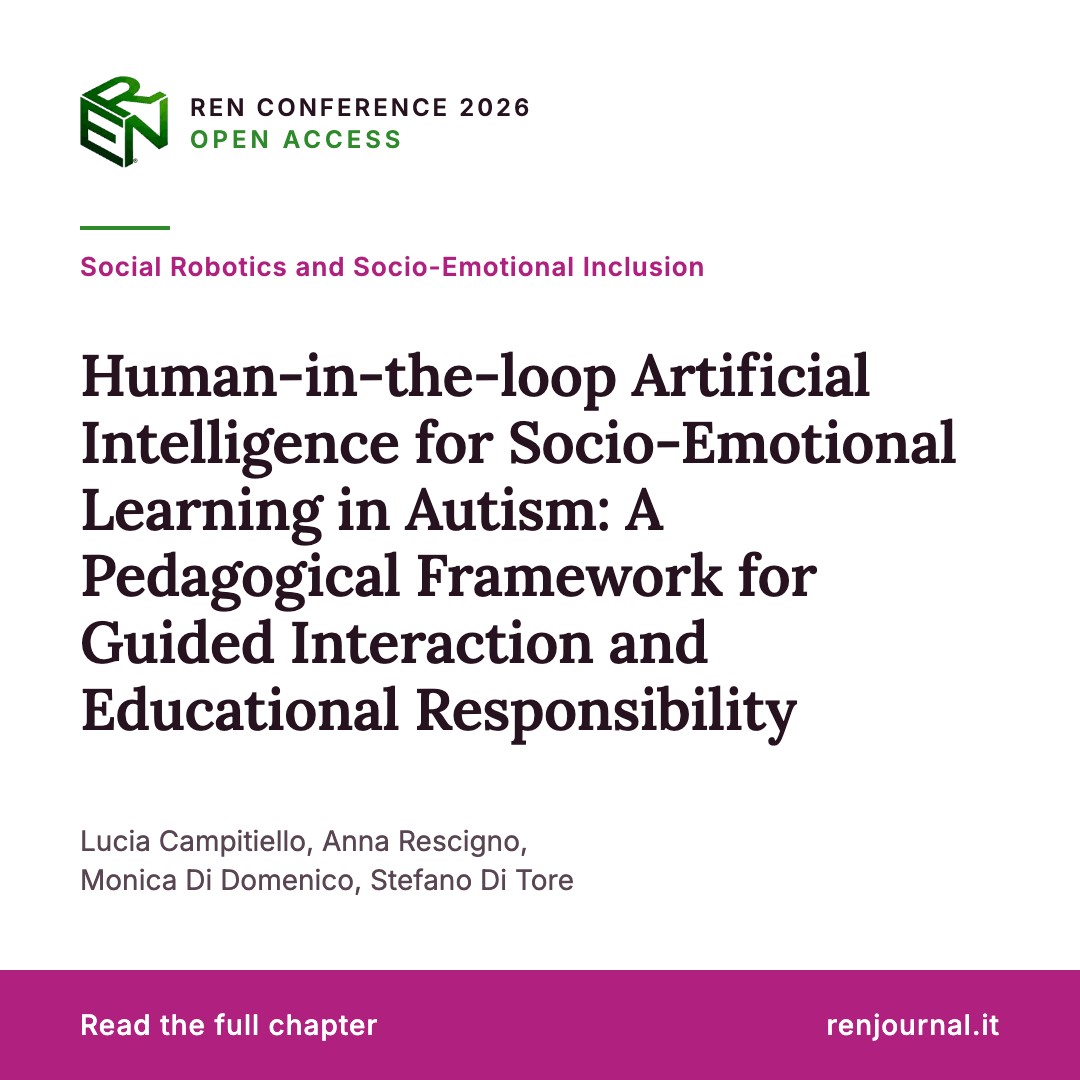
Authors: Lucia Campitiello, Anna Rescigno, Monica Di Domenico, Stefano Di Tore
The progressive integration of artificial intelligence into educational contexts is reshaping approaches to instructional mediation, the personalisation of learning pathways, and interaction with students. These potential applications are particularly relevant within the field of social and emotional learning (Goleman, 2011), especially for children with autism spectrum disorder (ASD), for whom structured and predictable learning environments characterised by gradual progression may foster the development of emotional and relational competencies. However, the use of generative artificial intelligence systems requires careful consideration of the implications associated with content reliability, process transparency, and the attribution of educational responsibility (Floridi, 2022). Indeed, the fluency and apparent plausibility of AI-generated responses do not guarantee their accuracy. Human supervision and validation processes are therefore essential to ensure that the content produced is scientifically grounded, pedagogically appropriate, and consistent with the intended learning objectives.
Read the full chapter (open access)
Published in: F. Peluso Cassese (Ed.), Algorithmic Heartbeats: Affective Education in the Age of the Fourth Revolution, REN Press, 2026, pp. 38–39
Section: Social Robotics and Socio-Emotional Inclusion
DOI: 10.5281/zenodo.23807037 · Licence: CC BY-NC-ND 4.0
How to cite: Campitiello, L., Rescigno, A., Di Domenico, M., & Di Tore, S. (2026). Human-in-the-loop Artificial Intelligence for Socio-Emotional Learning in Autism: A Pedagogical Framework for Guided Interaction and Educational Responsibility. In F. Peluso Cassese (Ed.), Algorithmic Heartbeats: Affective Education in the Age of the Fourth Revolution (pp. 38–39). REN Press. https://doi.org/10.5281/zenodo.23807037


Be First to Comment